What Is Non-Nano Zinc Oxide — And Why Does It Matter for Your Skin?
Share
Non-nano zinc oxide is showing up on more ingredient labels — and with it, a lot of questions. What does non-nano actually mean? How is it different from regular zinc oxide? And why do some people actively seek it out?
Here's a plain-language breakdown.
Key takeaways
- Non-nano zinc oxide is zinc oxide with particles larger than 100 nanometres — large enough that they sit on the skin's surface instead of absorbing into the body.
- It forms a physical mineral layer on the skin, acting as a barrier against wind, dust and salt water.
- It contains no chemical UV filters — no oxybenzone and no octinoxate.
- Nano zinc oxide (particles smaller than 100 nanometres) looks more transparent but may penetrate the skin barrier; non-nano leaves a slight white cast as the trade-off.
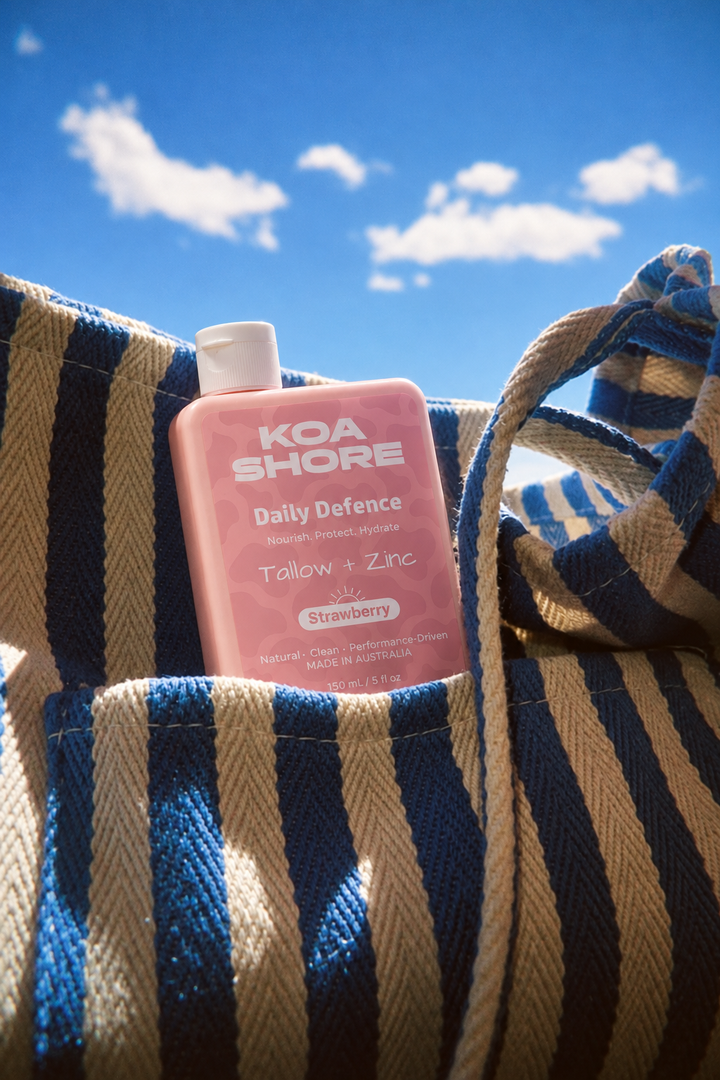
- Daily Defence uses non-nano zinc oxide alongside grass-fed tallow as a daily moisturiser; it is not a registered sunscreen and is not SPF tested.
What does "nano" mean in skincare?
Nano refers to particle size. One nanometre is one billionth of a metre — extremely small. In skincare, nanoparticles are intentionally engineered to be tiny, typically under 100 nanometres in diameter.
The reason manufacturers use nanoparticles is cosmetic: smaller particles spread more easily, sit more invisibly on the skin, and can feel lighter in texture. Regular zinc oxide — the kind used in traditional formulations — leaves a white cast. Nano zinc oxide doesn't.
So what's non-nano?
Non-nano zinc oxide has particles larger than 100 nanometres. It's the traditional form — not a newer innovation, just a way of specifying that the particle size hasn't been reduced to nano scale.
Because the particles are larger, non-nano zinc oxide doesn't penetrate the skin's surface. It sits on top of the skin rather than being absorbed into it. That's the key distinction.
Why does absorption matter?
The concern with nanoparticles is straightforward: if particles are small enough to cross the skin barrier and enter the bloodstream, their long-term effects are less understood. Research is ongoing and regulatory bodies in different countries take different positions on this. The TGA, for instance, has assessed nano zinc oxide and noted that while evidence suggests limited penetration in healthy skin, it continues to monitor ongoing research.
Non-nano zinc oxide sidesteps the question entirely. It stays on the surface. It doesn't absorb into the body. What you put on is what stays on — and what eventually washes off.
For people who are paying attention to what enters their body through their skin, that distinction matters.
Nano vs non-nano at a glance
| Feature | Non-nano zinc oxide | Nano zinc oxide |
|---|---|---|
| Particle size | Larger than 100 nanometres | Smaller than 100 nanometres |
| Where it ends up | Sits on the skin's surface | May penetrate the skin barrier |
| Appearance on skin | Can leave a slight white cast | More transparent |
| TGA status | Standard ingredient | Under ongoing review |
| Common in | Mineral and clean-label formulas | "Invisible" cosmetic formulas |
What non-nano zinc oxide actually does on skin
On the skin's surface, non-nano zinc oxide forms a physical mineral layer. Think of it as a barrier between your skin and the environment — wind, dust, salt water, the general contact that comes with being outside.
It's why zinc-based formulations have been used on skin for a long time — in nappy rash creams, wound care, and mineral-based cosmetics. The mineral sits on top and forms a barrier. Simple chemistry, long track record.
Beyond the barrier itself, zinc brings a few well-documented properties to the table:
- Skin soothing: zinc has been used to calm and settle irritated skin for decades.
- Sebum regulation: research suggests zinc may help moderate oil production — relevant for combination and breakout-prone skin.
- Mildly antimicrobial: zinc may help reduce the bacteria associated with breakouts.
To be clear: non-nano zinc oxide in Daily Defence is not a registered sunscreen and Daily Defence is not SPF tested. It is a daily moisturiser that includes non-nano zinc oxide as a mineral skin barrier ingredient.
No oxybenzone. No octinoxate.
Chemical UV filters like oxybenzone and octinoxate work differently — they absorb UV energy and convert it to heat. They're found in most conventional sunscreens.
Some people prefer to avoid them — whether because of how they interact with the body, or because of their environmental impact (oxybenzone in particular has been linked to coral reef damage, which is why some regions have banned it).
Non-nano zinc oxide doesn't involve any of that. It's a mineral. It sits on the skin. It doesn't convert or react with anything. We've written a fuller comparison here: Zinc Oxide vs Chemical UV Filters: What's Actually in Your Skincare?
How to spot non-nano zinc oxide on a label
Ingredient lists just say "zinc oxide" — particle size isn't required on the label. A few ways to check:
- Look for "non-nano" in the product copy. If a brand has gone non-nano, they'll usually say so.
- Ask the brand directly. Reputable brands know their zinc oxide particle size and will share it readily.
- Be wary of "transparent zinc" claims without further detail. Transparency is usually achieved through nanoparticle sizing, not clever formulation.
Why we use it in Daily Defence
Daily Defence is built around two ingredients: grass-fed tallow and non-nano zinc oxide. The tallow handles deep moisture — its fatty acid profile closely mirrors the skin's own natural oils, so it absorbs well and nourishes where synthetic moisturisers sit on the surface.
The non-nano zinc oxide adds the mineral layer on top. For people who spend time outside — in the water, in the wind, in the sun — having that physical barrier on the skin makes sense as part of a daily routine.
150ml. Both ingredients. One bottle. Shop Daily Defence.
Common questions
What is non-nano zinc oxide?
Non-nano zinc oxide is zinc oxide with a particle size larger than 100 nanometres. Because the particles are bigger, it sits on the surface of your skin rather than absorbing into the body, forming a physical mineral layer. It's the traditional, non-engineered form of the mineral.
What does non-nano zinc oxide mean?
"Non-nano" describes the particle size — larger than 100 nanometres. It means the zinc oxide hasn't been shrunk to nano scale, so it stays on the skin's surface instead of penetrating it. Same mineral, larger particles.
Is non-nano zinc oxide safe?
Non-nano zinc oxide is widely regarded as well tolerated. Because the larger particles stay on the surface rather than absorbing into the body, it avoids the penetration questions raised about nano-sized particles. Zinc has a long track record in skin preparations, from nappy-rash creams to mineral cosmetics.
How does zinc oxide absorb UV rays?
Zinc oxide is a broad-spectrum mineral UV filter — it absorbs and scatters UV light across UVA and UVB, which is why it's used as the active ingredient in mineral sunscreens. One important distinction: a moisturiser that simply contains zinc oxide is not automatically a sunscreen. Daily Defence is not SPF tested or registered as a sunscreen, so don't rely on it for sun protection — it uses non-nano zinc oxide as a surface mineral barrier ingredient, not a tested sunscreen active.
Is non-nano zinc oxide safe for sensitive skin?
Yes — it's generally considered well tolerated, including on sensitive skin. Because it sits on the surface rather than absorbing in, it avoids the systemic concerns associated with some chemical alternatives. Zinc has a long history in soothing preparations, from nappy rash creams to dermatological treatments.
Does non-nano zinc oxide leave a white cast?
It can, depending on concentration and formulation. The larger particles scatter more visible light, which can create a slight white appearance — more noticeable on deeper skin tones. Nanoparticles were developed partly to fix that aesthetic issue, but at the cost of greater uncertainty around skin absorption.
Can I use non-nano zinc oxide every day?
Yes — it's considered safe for daily use as a topical ingredient, and it's commonly found in daily barrier products. It isn't associated with the irritation or hormonal disruption concerns linked to some chemical alternatives.
The short version
Non-nano zinc oxide is zinc oxide with particles large enough that they don't absorb through the skin. It sits on the surface and forms a physical mineral layer. It contains no chemical UV filters. Daily Defence uses it alongside grass-fed tallow as a daily moisturiser — not as a registered sunscreen, and not SPF tested.
If you care about what stays on the surface versus what goes in — that's the distinction worth knowing.
Read next:
Tallow Moisturiser vs Regular Moisturiser: What's Actually Different?
The Best Moisturiser for Outdoor Skin in Australia
How to Build a Simple Natural Morning Skin Routine (Without 6 Products)
If you want the practical side — how non-nano zinc actually pairs with tallow in a daily moisturiser, what the white cast looks like, and how to pick a good one in Australia — we wrote a separate guide on that.
Related reading
The Tallow + Zinc Honest Australian Guide
Zinc Oxide vs Chemical UV Filters: What's Actually in Your Skincare?
Benzene in Skincare, Explained — And Why We List All 15 Ingredients
Why two hero ingredients