Zinc Oxide vs Chemical UV Filters: What's Actually in Your Skincare?
Share
Most people have no idea what's in their sunscreen or moisturiser. They know one number: SPF. But beneath that number sits a list of ingredients — some mineral, some synthetic — that are getting increasing scrutiny from researchers, regulators, and consumers.
This article looks at zinc oxide versus chemical UV filters: what they are, how they work, and why the difference matters to anyone thinking seriously about what goes on their skin every day.
What Are Chemical UV Filters?
Chemical UV filters are synthetic molecules that absorb UV radiation and convert it to heat, which is then released from the skin. Common examples include oxybenzone, avobenzone, octinoxate, octisalate, homosalate, and octocrylene. Most commercial sunscreens contain several of these in combination.
They are widely used because they spread easily, feel lightweight, and don't leave a visible residue. But their defining characteristic — absorption into the skin — is also the source of growing concern.
What the Research Shows About Chemical UV Filter Absorption
In 2019, the FDA published a study in JAMA (the Journal of the American Medical Association) that found four common chemical UV filters — avobenzone, oxybenzone, octocrylene, and ecamsule — were absorbed into the bloodstream after a single application, at concentrations that exceeded FDA safety thresholds for investigation.
A separate issue surfaced in 2021, when independent testing firm Valisure found benzene — a known carcinogen — in multiple sunscreen products, with some containing concentrations up to 2 parts per million. Benzene is not an intentional ingredient; it appears as a contaminant in the manufacturing process of certain chemical filters including octocrylene.
Neither finding represents proof of harm at typical use levels. But they represent a meaningful shift in how the safety of chemical UV filters is being evaluated — by scientists, if not always yet by regulators.
Zinc Oxide vs Chemical UV Filters: Side-by-Side Comparison
| Feature | Zinc Oxide (Non-Nano) | Chemical UV Filters |
|---|---|---|
| Mechanism | Reflects UV from skin surface | Absorbs UV, converts to heat |
| UV coverage | Broad-spectrum (UVA + UVB) | Varies by compound; often combined |
| Skin absorption | Stays on skin surface | Detected in bloodstream after application |
| Hormone disruption concern | None established | Oxybenzone linked to potential endocrine activity |
| Reef safety | Generally considered reef-safe | Oxybenzone and octinoxate banned in some reef-protected areas |
| Appearance on skin | May leave slight white cast | Cosmetically invisible |
| Stability in sunlight | Photostable | Some degrade in UV (e.g. avobenzone) |
The Oxybenzone Question
Oxybenzone deserves a closer look because it appears in a large proportion of Australian sunscreens and moisturisers with SPF.
Multiple studies have found that oxybenzone behaves as an endocrine disruptor in laboratory settings — interfering with oestrogen and testosterone signalling in cell and animal models. The concentrations used in some of these studies are higher than typical skin exposure, so direct extrapolation is disputed. However, Hawaii, Palau, and the US Virgin Islands have banned oxybenzone-containing products based on evidence of reef toxicity, and the FDA has acknowledged that more safety data is needed before it can declare oxybenzone generally recognised as safe.
This does not make oxybenzone definitively dangerous at typical use levels. But it does mean the precautionary argument for non-nano zinc oxide — which has a clear, understood mechanism and does not absorb into skin — carries real weight.
What This Means for Daily Skincare, Not Just Sunscreen
The conversation usually centres on sunscreens, but chemical UV filters also appear in moisturisers, foundations, lip balms, and serums — products many people apply daily, year-round. Cumulative exposure over months and years looks different to a single-application study.
For daily skincare, the zinc oxide case becomes stronger. You are applying it repeatedly, not just at the beach. An ingredient that stays on the skin surface — reflecting rather than absorbing — avoids the bioaccumulation question entirely.
Note: Koa Shore Daily Defence is not a registered sunscreen and does not carry an SPF rating. It is not a substitute for TGA-approved sun protection products.
How to Check Your Skincare for Chemical UV Filters
Common chemical UV filters to be aware of on ingredient labels:
- Benzophenone-3 (oxybenzone)
- Butyl methoxydibenzoylmethane (avobenzone)
- Ethylhexyl methoxycinnamate (octinoxate)
- Homosalate
- Octocrylene
- Ethylhexyl salicylate (octisalate)
If zinc oxide is listed, check whether the product specifies non-nano. If it doesn't mention particle size, the manufacturer may not be using a non-nano formulation. Learn more in our article on what non-nano zinc oxide is and why it matters.
Frequently Asked Questions
Is zinc oxide safer than oxybenzone?
Non-nano zinc oxide has a better-established safety profile for systemic exposure than oxybenzone. It does not absorb into the bloodstream in meaningful quantities, while oxybenzone has been detected systemically after standard application. That said, oxybenzone has not been proven harmful at typical use levels — the precautionary argument is about ongoing uncertainty, not confirmed danger.
What are chemical UV filters in skincare?
Chemical UV filters are synthetic compounds added to skincare and sun protection products to absorb UV radiation. They include oxybenzone, avobenzone, octinoxate, homosalate, and octocrylene. Unlike zinc oxide, they work by absorbing UV energy and converting it to heat, rather than reflecting it from the skin surface.
Do chemical sunscreens absorb into the bloodstream?
Yes. A 2019 FDA-sponsored study published in JAMA found that four common chemical UV filters — avobenzone, oxybenzone, octocrylene, and ecamsule — were detectable in the bloodstream after a single application and exceeded FDA thresholds for safety investigation. The FDA has called for additional safety research but has not restricted their use.
Can I use zinc oxide every day instead of chemical UV filters?
Non-nano zinc oxide is commonly used in daily skincare products as a skin barrier and UV-reflective ingredient. It is considered safe for daily use and is not associated with the systemic absorption concerns linked to some chemical UV filters.
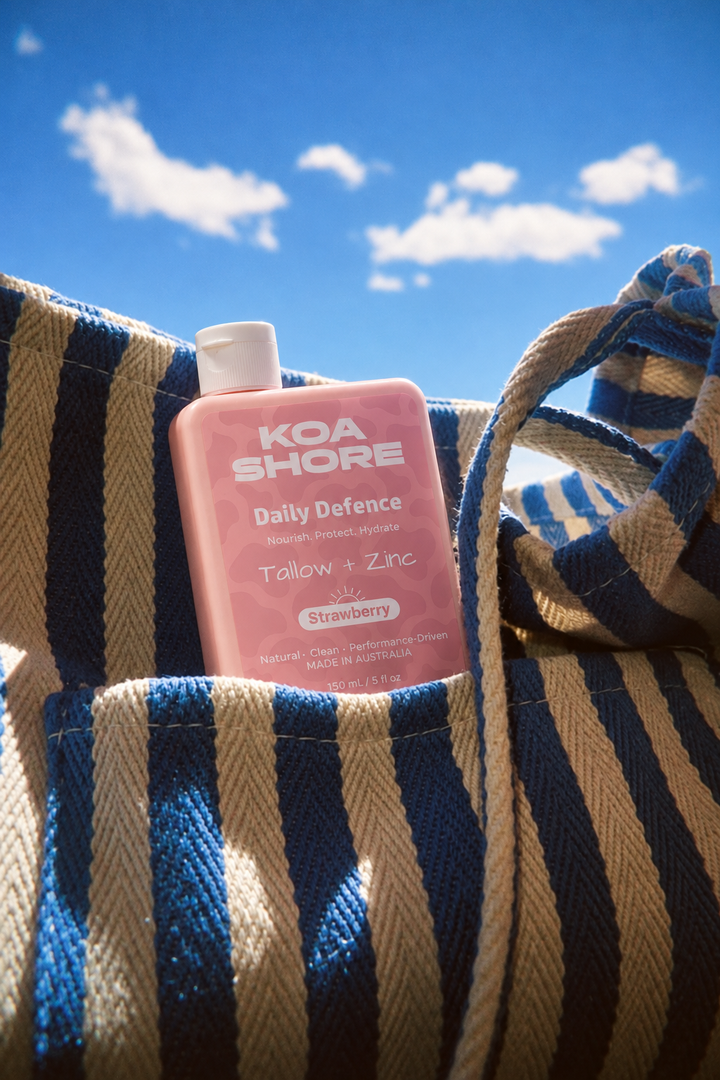
Koa Shore Daily Defence uses non-nano zinc oxide in a grass-fed tallow base — covering both deep moisture and mineral barrier in one step. Shop Daily Defence, or explore our full ingredients list and our guide to a simple natural morning routine.
Related reading
The Tallow + Zinc Honest Australian Guide
What Is Non-Nano Zinc Oxide — And Why Does It Matter for Your Skin?
Benzene in Skincare, Explained — And Why We List All 15 Ingredients
What to Put on Your Face Before the Beach (The Honest Version)