Grass-Fed Tallow for Skin: Does It Actually Work?
Share
Beef tallow as a skincare ingredient gets a predictable reaction: people are either immediately on board or immediately skeptical. If you're in the second camp, this is for you.
Here's the honest version — what tallow actually is, why the grass-fed part matters, what it does on skin, and what it doesn't do.
Key takeaways
- Tallow is rendered beef fat — a shelf-stable fat that has been used in skincare for centuries, not a new ingredient.
- Grass-fed tallow is richer than grain-fed in oleic acid, conjugated linoleic acid (CLA) and the fat-soluble vitamins A, D, E and K.
- Tallow's fatty acids — oleic, stearic and palmitic acid — closely match those in human skin, so it absorbs into the skin's lipid layer rather than sitting on top.
- A little goes a long way: a pea-sized amount absorbs within a couple of minutes, so start with less than you think you need.
- Tallow is a moisturiser, not a medicine; it is not a sunscreen and is not SPF tested.
What is tallow?
Tallow is rendered beef fat. The rendering process — slow-cooking the fat to separate the pure fat from the connective tissue and water — produces a shelf-stable, clean fat that's been used for centuries in food, candles, and skincare.
It's not a new ingredient. It fell out of fashion in the second half of the twentieth century as synthetic alternatives became cheaper to produce at scale. Now it's coming back, for the same reason a lot of older things come back: people started reading ingredient labels and asking what they were actually putting on their skin.
Why grass-fed specifically?
The fatty acid profile of beef tallow changes depending on what the animal ate. Grass-fed beef tallow has a higher concentration of oleic acid, conjugated linoleic acid (CLA), and fat-soluble vitamins — particularly A, D, E and K.
Grain-fed tallow has a different ratio. It's not that it doesn't work — it's that grass-fed tallow is nutritionally richer and has a fatty acid composition that more closely mirrors what's found in human skin.
That last point is the key one.
Why does the fatty acid match matter?
Human skin cell membranes are largely made of fatty acids — oleic acid, stearic acid, palmitic acid. These are the same fatty acids that make up beef tallow in significant concentrations.
When you apply a fat that your skin's biology already recognises, it absorbs differently than a fat or polymer that's foreign to it. Synthetic moisturisers often sit on the skin's surface and form a film that slows water loss — functional, but passive. Tallow absorbs into the lipid layer.
That's not a claim about treatment or outcomes. It's basic chemistry: like dissolves like. Your skin's lipid layer is made of fats. Fats with a similar structure integrate rather than repel.
Does it feel greasy?
This is the main practical objection. The honest answer is: it depends on how much you use.
Tallow is denser than a water-based cream. A small amount goes a long way — people consistently find they use less than they expect and still get coverage. Used correctly (a pea-sized amount, worked into the skin), it absorbs within a couple of minutes and doesn't leave a heavy residue.
Used like a water-based moisturiser — scooped on generously — it will feel heavier than you want. Start with less than you think you need.
What tallow doesn't do
Clear list, no ambiguity:
- Tallow is not a sunscreen and is not SPF tested
- It will not treat, cure or prevent any skin condition
- It is not a medicine
- It is not a substitute for medical advice
It is a moisturiser made from a fat that your skin's biology is familiar with. That's the claim — nothing more.
What about the smell?
Properly rendered tallow has a mild, faintly nutty smell — nothing like the raw fat. Most people find it neutral to pleasant. It's much less present than most scented moisturisers.
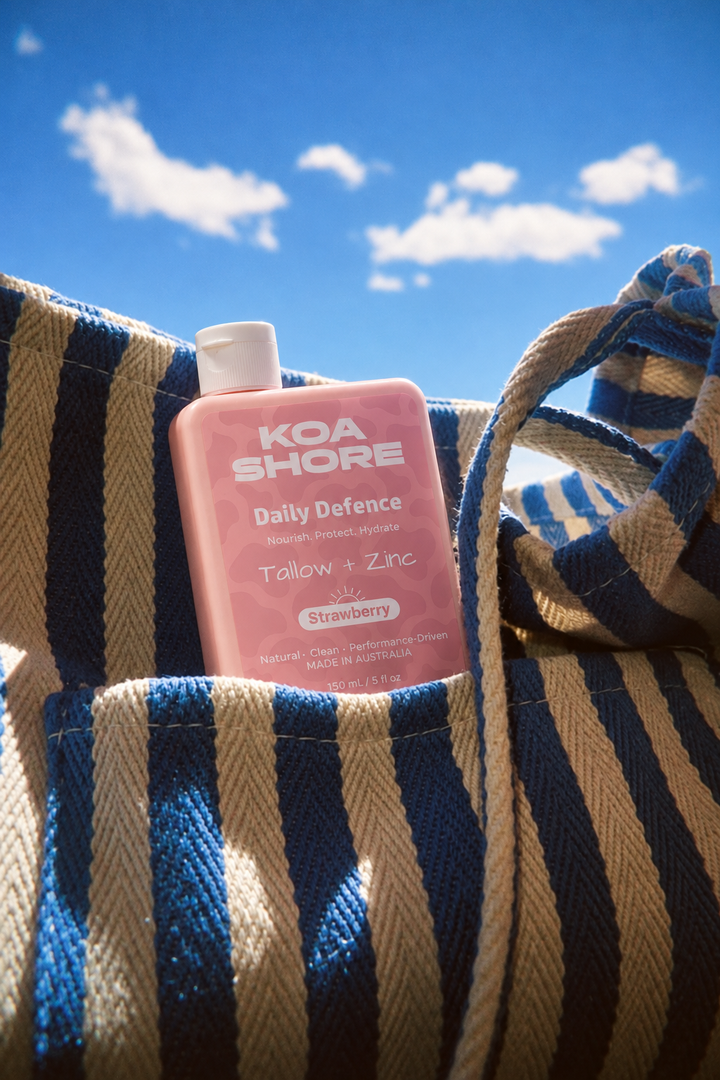
Daily Defence by Koa Shore uses grass-fed tallow alongside non-nano zinc oxide, in Coconut Lime and Strawberry scents — both light enough that they don't compete with whatever else you're wearing.
So does it work?
For most people who try it: yes. Skin feels nourished rather than just coated. It holds up through outdoor activity better than water-based creams. People tend to use less product and reapply less often.
Whether that's the fatty acid similarity, the fat-soluble vitamins, or simply the density of a properly formulated fat-based moisturiser — the feedback is consistent.
The skepticism is fair. The ingredient is unusual. But the chemistry behind it isn't complicated, and it has a long enough track record — longer than most synthetic alternatives — that it's worth trying if you're curious.
Daily Defence is 150ml of grass-fed tallow and non-nano zinc oxide in one bottle. $44.99 AUD. Made in Australia. Shop here, or compare it against the rest in our guide to the best tallow balm and moisturiser in Australia.
Read next:
Tallow Moisturiser vs Regular Moisturiser: What's Actually Different?
The Best Moisturiser for Outdoor Skin in Australia
For the broader context — including how tallow stacks up against the rest of the Australian moisturiser category and what to actually look for when buying — see our honest breakdown of tallow + zinc moisturisers in Australia.
Related reading
The Tallow + Zinc Honest Australian Guide
Is Beef Tallow Comedogenic? Will It Clog Your Pores?
Tallow Moisturiser Australia: The Ancestral Skincare Making a Comeback
Does Tallow Smell Beefy? An Honest Answer About Tallow Skincare