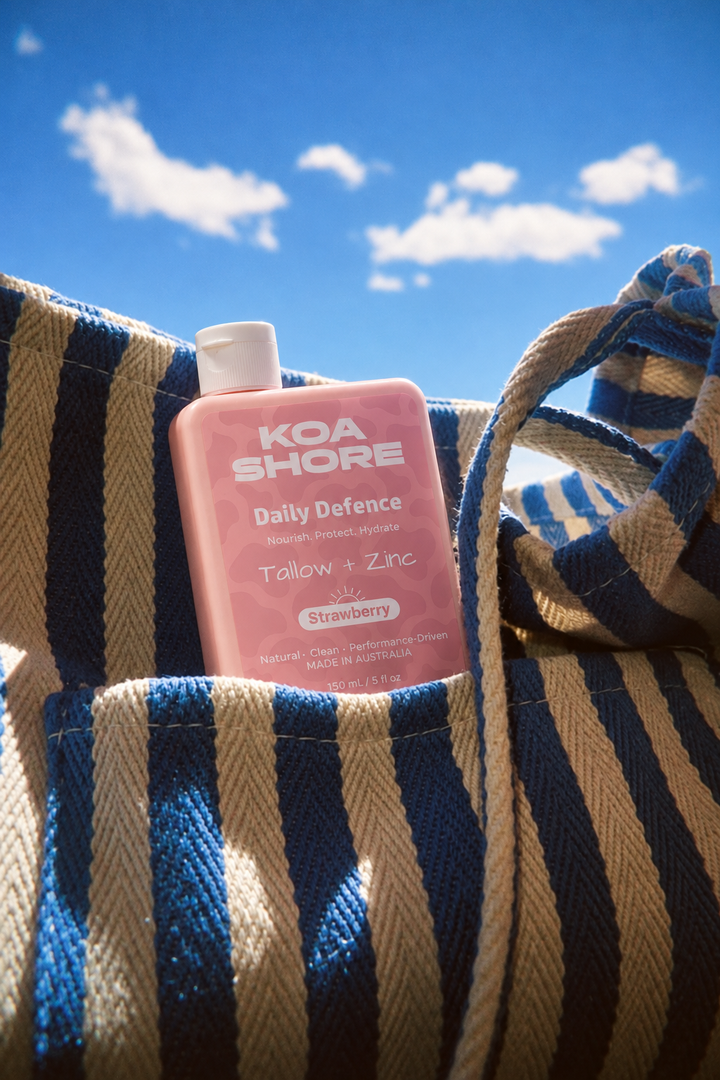
Why two hero ingredients.
Share
Notes from the bench · 01
There's a moment in skincare shopping where you flip the bottle, scan the ingredient list, and lose the plot at "phenoxyethanol." If you can't pronounce it, the brand bets, you won't question it.
We took a different bet.
Daily Defence has five hero ingredients. Two of them do the heavy lifting. Three of them support. Plus the technical bits any real emulsion needs to stay an emulsion — we'll get to those.
The two heroes.
The two heroes are tallow and non-nano zinc oxide. Tallow because the fatty acid profile mirrors human sebum almost exactly — your skin recognises it instantly, no fighting. Zinc because it sits on the skin as a physical mineral barrier rather than being absorbed into the body, and it's been doing that for a hundred years before we knew why it worked.
The three supporting.
MCT oil, vitamin E, and olive oil. They're there for one job each: MCT helps everything spread and absorb cleanly. Vitamin E is an antioxidant that keeps the formula stable. Olive oil softens. None of them are filler. None of them are hiding.
The technical bits.
Every cream is an emulsion — oil and water held together. Without an emulsifier system, they separate. Without a preservative, they spoil. Without water, you don't have a cream. So Daily Defence has those too: a plant-derived emulsifier system, a coconut-derived preservative, and water. They're not filler. They're the chemistry that makes the formula work. The full INCI list — fifteen ingredients, no asterisks — is on the ingredients page.
Two heroes. Three supporting. Plus the technical bits. Everything on the label.
The reason we don't pad the formula isn't ideology — it's that we couldn't find a sixth hero ingredient that earned its place. We tried. Most additives in skincare exist to extend shelf life, to add fragrance that masks other ingredients, or to thicken cheaper carriers. We didn't need any of those.
— Morgan, founder.
Next.
If you want the deeper dive — what tallow and non-nano zinc actually do, what they don't (it's not a sunscreen), and how to read a label so you don't get burned — start with our full guide for Australian readers.
Read next:
Grass-Fed Tallow for Skin: Does It Actually Work?
What Is Non-Nano Zinc Oxide — And Why Does It Matter for Your Skin?
Tallow Moisturiser vs Regular Moisturiser: What's Actually Different?
Related reading
The Tallow + Zinc Honest Australian Guide
Grass-Fed Tallow for Skin: Does It Actually Work?
What Is Non-Nano Zinc Oxide — And Why Does It Matter for Your Skin?
Tallow Moisturiser vs Regular Moisturiser: What's Actually Different?